

Work through each section in order. Use the practice tests linked throughout to check your progress as you go. All resources on this page are completely free.
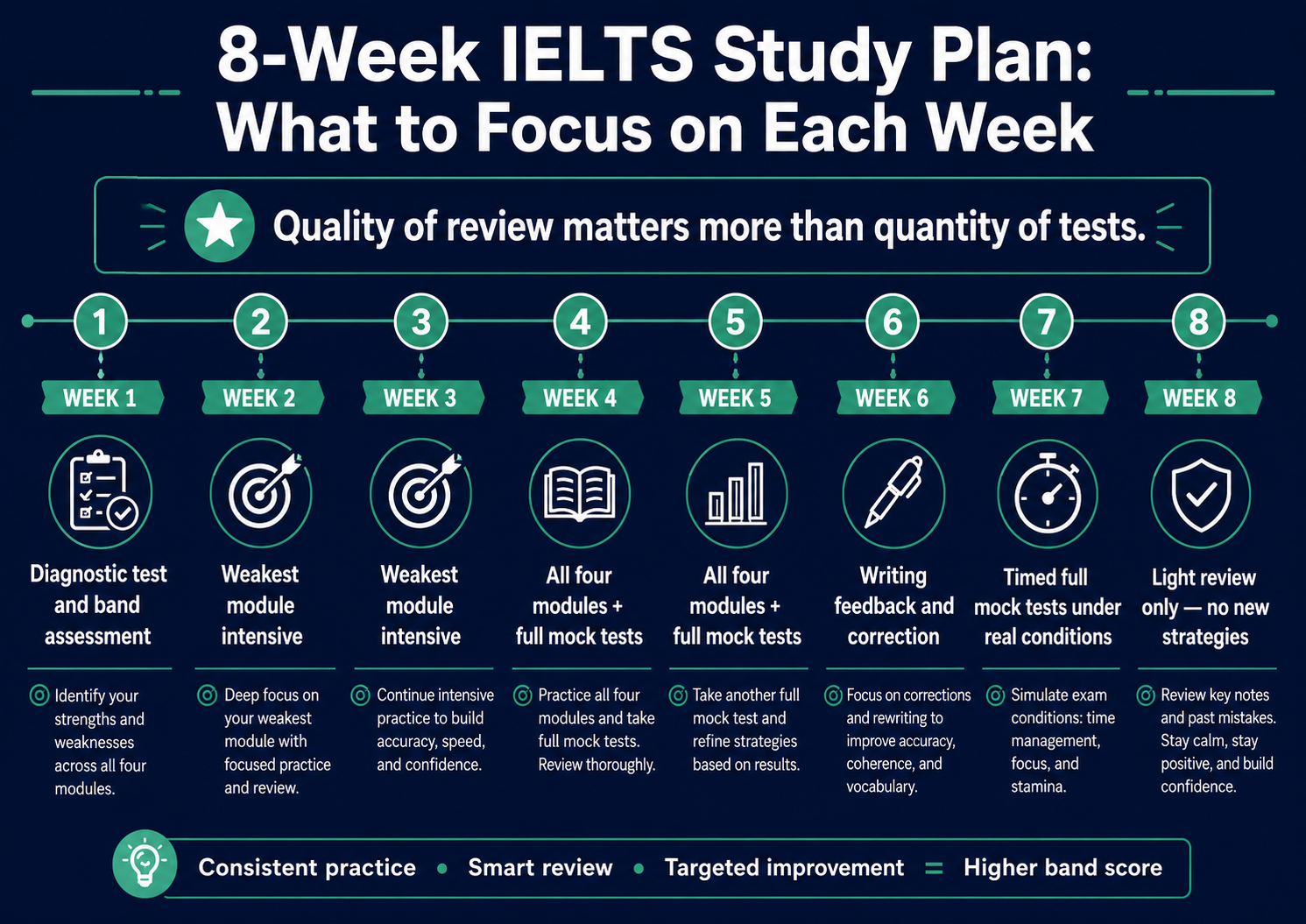
Effective IELTS preparation takes between 6 and 12 weeks for most candidates, depending on your current English level and target band score. The key is consistent daily practice across all four modules, not occasional long study sessions on one skill. Most candidates underestimate how much time they need for Writing and Speaking, where improvement is slowest.
Preparation at a glance
For the high-level framework, consult the official IELTS preparation overview.
Before you start any structured preparation, take a full mock test. Knowing your current band in each module determines everything else, your timeline, your weakest module, your priority areas. Our free practice tests include all four modules with band score calculators.
The four module preparation guides
Each IELTS module has its own dedicated preparation guide with week-by-week study plans and module-specific techniques. Start with whichever module is your current weakness.
Reading preparation guide
Strategy and time management for the 14 question types. Includes a 6-week study plan for moving from band 6 to band 7.
View Reading guide → WritingWriting preparation guide
Task 1 and Task 2 approaches, with band 5 vs band 7 example comparisons and a structured weekly improvement plan.
View Writing guide → ListeningListening preparation guide
Accent training, prediction skills and the 30-45 second preparation routine for each section.
View Listening guide → SpeakingSpeaking preparation guide
Part 1, Part 2 cue cards and Part 3 abstract discussion techniques. Includes recording-based practice methods.
View Speaking guide →Realistic timelines by starting band
Improvement rates in IELTS are predictable. Faster gains happen at lower bands; gains slow significantly above band 7. These timelines assume consistent daily practice of 1-2 hours.
Band 5 → Band 6: 6-8 weeks
Band 6 → Band 6.5: 4-6 weeks
Band 6.5 → Band 7: 8-10 weeks
Band 7 → Band 7.5: 10-14 weeks
Band 7.5 → Band 8: 12-16 weeks
Band 8 → Band 8.5: 6+ months
If your target requires more than 6 months of preparation from your current band, consider whether a structured course with feedback from teachers might be more effective than self-study. Some plateaus only break with external evaluation.
The most common stuck-point is band 6.5 in Writing or Speaking. The cause is almost always the same, practising without feedback. You repeat the same mistakes endlessly without knowing they are mistakes. Getting your writing marked by a qualified examiner is what breaks this plateau.
Which plan fits your timeline?
The right plan depends on how far you are from your target and how long you have, not just your test date. As a rough guide, Cambridge research suggests about 100 to 200 hours of focused study to move up one full band, so roughly 50 to 100 hours for each half band.
| If you have | Best focus |
|---|---|
| About 1 month, already near your target | Exam technique and timing. Sit full timed mocks and fix your single weakest skill. |
| About 3 months, the most common case | Build vocabulary and writing, practise all four skills, and take a full mock each week. |
| 6 months or more, building from a lower base | Raise your general English first, then add exam technique on top. Plateaus above band 7 usually need feedback. |
Daily practice habits that work
Effective IELTS practice is not about hours logged. It is about specific habits that build the right skills.
Read in English every day, 30 minutes minimum
Newspaper articles, blog posts, magazines on any topic that interests you. Reading widely builds vocabulary, sentence pattern familiarity and reading speed simultaneously. The Economist, BBC News, National Geographic and Scientific American match IELTS Academic difficulty.
Listen to native English content daily
Podcasts, news radio, lectures from YouTube or Coursera. Aim for 20-30 minutes per day across different accents. Active listening with notes is more effective than passive listening while doing other tasks.
Write one full essay per week, get it marked
Writing without feedback is practising mistakes. Once weekly is enough, what matters is quality of feedback, not quantity of essays. If you cannot afford a teacher, find a study partner at similar or higher band level for peer review.
Speak English aloud every single day
Even alone. Even just describing what you did today. The physical act of producing English sentences builds fluency in a way silent practice cannot. Recording yourself once a week and listening back identifies pronunciation issues you cannot hear in real time.
What to do in the final two weeks
The two weeks before your test should look different to your earlier preparation. This is consolidation time, not learning time.
Take full mock tests
Complete test under timed conditions 2-3 times a week
Review every error
Understand why each wrong answer was wrong
Limit new vocabulary
Consolidate words you already know, do not add new ones
Sleep and rest
Last 2 days should be light review, not intensive study
Studying intensively the day before the test. Your performance on test day depends on how rested and clear-headed you are, not how much you crammed the previous night. The day before should be a light review and an early bedtime, nothing more.
Choose your preparation path
Resources you actually need
The IELTS preparation industry is full of books, courses and apps. Most candidates do not need them all. These are the resources we recommend for self-study:
- Cambridge IELTS books 15-18. The most recent four books contain authentic past papers. Our Cambridge guide covers which to start with and where to find answers.
- The Official IELTS Practice Materials. Published by IDP and British Council. Two free practice tests per module.
- One quality grammar reference. Murphy's "English Grammar in Use" is the standard for self-study and covers everything tested in IELTS.
- A vocabulary notebook. Old-fashioned but effective. Write down new words you encounter with their context, not just translation.
You do not need to buy 12 different IELTS books. Two or three high-quality resources, used thoroughly, beat a shelf of half-used books.
Frequently asked questions
How long does IELTS preparation take?
Most candidates need 6 to 12 weeks of consistent daily preparation. Going from band 5 to band 6 typically takes 6-8 weeks, while going from band 6.5 to band 7 takes 8-10 weeks. Higher bands require longer, band 7.5 to band 8 can take 3-4 months.
Is self-study enough or do I need a teacher?
Self-study works well for Reading and Listening because you can mark your own answers and identify weaknesses. For Writing and Speaking, getting feedback from a qualified teacher or examiner is much more efficient than self-study above band 6. The plateau most candidates hit at band 6.5 is usually broken by external feedback, not more solo practice.
How many hours per day should I study?
1-2 hours per day, spread across all four modules, is more effective than 4 hours on one module. Consistent daily practice beats sporadic long sessions. If you can only do 30 minutes some days, do 30 minutes, do not skip the day entirely.
Should I take IELTS multiple times to improve my score?
Only if your preparation between attempts has been significantly different. Retaking IELTS without changing your approach typically produces the same score. Use each attempt to identify weaknesses, then prepare differently before the next test.
Can I improve my band score in 2 weeks?
Honestly, not by much. Two weeks is enough to improve test strategy and avoid silly errors, which might lift your score by 0.5 band if you are scoring below your potential. Genuine improvement in English ability takes months, not weeks.