

IELTS scores range from 0 to 9 in half-band increments. Your overall band score is the average of your four module scores, rounded to the nearest half band. Each institution sets its own minimum band requirements.
IELTS Listening band scores are calculated from your raw score out of 40, using a fixed conversion table that is identical for Academic and General Training candidates. You need 30 correct answers to reach band 7.0, 32 for band 7.5, and 35 for band 8.0. Each correct answer is worth one mark with no partial credit, and there is no penalty for wrong answers, so always guess if you are unsure.
Once you know your Listening raw score, calculate your overall IELTS band by combining it with your other section scores.
Listening scoring is the same for Academic and General Training. Choose the next action that helps your preparation.
Listening band score at a glance
The raw-score to band conversion is published in the official IELTS scoring guide.
The Listening conversion is the same for both Academic and General Training test types. This is different from Reading, where General Training requires more correct answers for the same band because the texts are easier overall. The Listening recording difficulty is consistent across both versions.
Complete raw score to band conversion table
The official conversion may vary slightly between test sessions, but the table below reflects the standard scoring used in most IELTS tests. Use this to estimate your band score from any Listening practice test you complete.
| Band score | Raw score out of 40 | What this represents |
|---|---|---|
| Band 9.0 | 39-40 | Expert user, near-perfect listening comprehension |
| Band 8.5 | 37-38 | Very good user with occasional misses |
| Band 8.0 | 35-36 | Very good user, handles all section types well |
| Band 7.5 | 32-34 | Good user, occasional difficulty with Section 4 |
| Band 7.0 | 30-31 | Good user, common university minimum |
| Band 6.5 | 26-29 | Competent user, common visa minimum |
| Band 6.0 | 23-25 | Competent user with noticeable gaps |
| Band 5.5 | 18-22 | Modest user, struggles with academic content |
| Band 5.0 | 16-17 | Modest user, basic competence only |
| Band 4.5 | 13-15 | Limited user, frequent miscomprehension |
| Band 4.0 | 10-12 | Limited user, basic familiar contexts only |
The gap from band 6.5 to band 7 requires only 4 more correct answers (26 to 30), but those 4 answers usually come from Sections 3 and 4. Most candidates plateau because they keep scoring well on Sections 1 and 2 but cannot improve on the harder sections.
Choose your next Listening step
Your score is most useful when it changes what you practise next. Choose learning support or realistic timed practice.
Review answers with explanations
Check Cambridge IELTS 18 to 21 Listening answers. Use the explanations to find spelling, distractor and instruction errors.
Browse Listening AnswersTest your score under exam conditions
Complete a full Listening test. Compare the result with the conversion table and track your progress.
Start Timed Listening Practice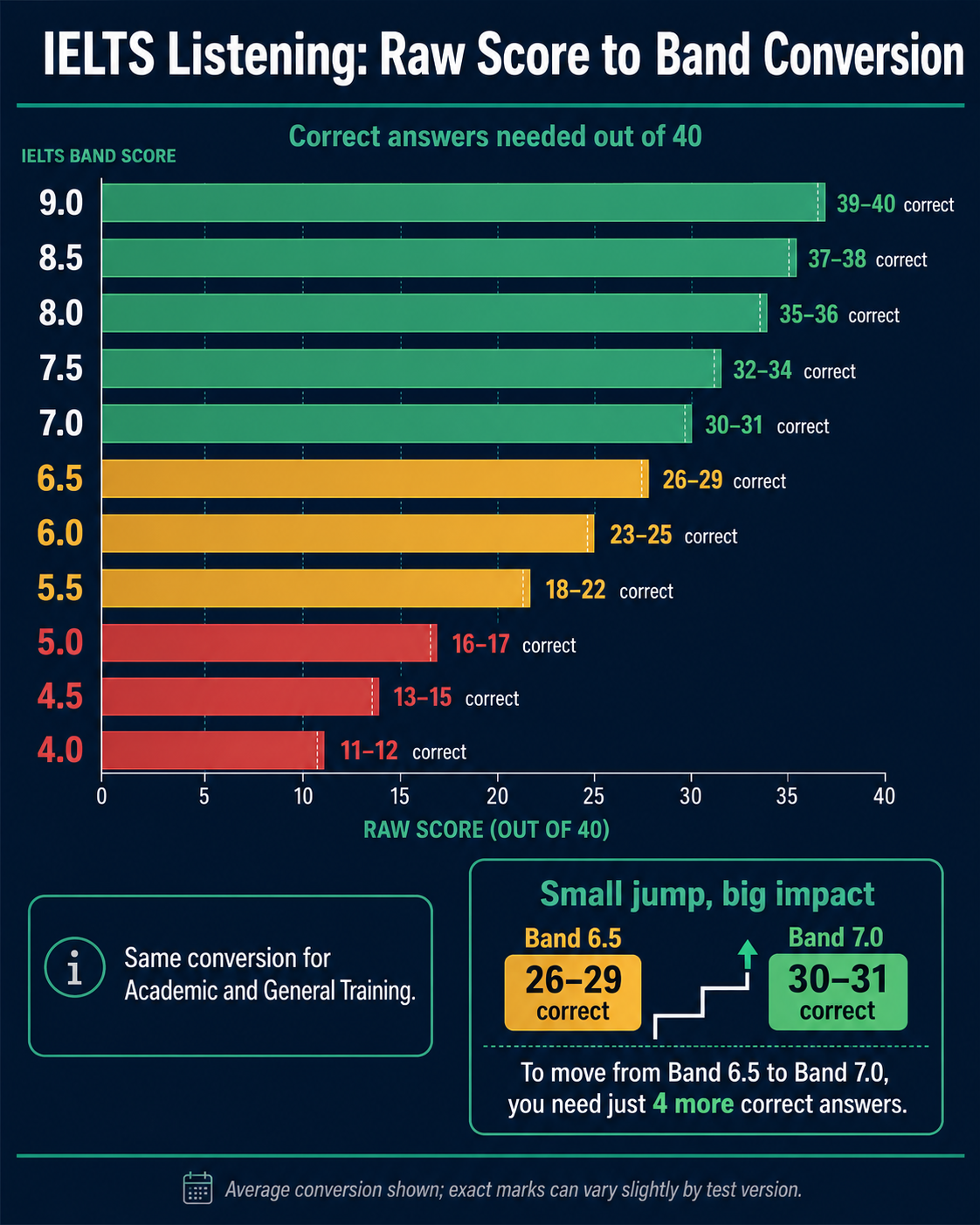
How band scores translate to ability
Beyond the raw numbers, each band represents a meaningful difference in listening ability. The descriptors below explain what each band score actually means in practice:
- Band 9. Native-speaker-equivalent listening. Understands all four sections including rapid speech with multiple accents, complex academic content, and informal colloquial language.
- Band 8. Very strong listening across all sections. Occasional difficulty only with highly specialised vocabulary or very rapid speech.
- Band 7. Good listening with occasional misses. Comfortable with Sections 1-3, may struggle slightly with the most complex Section 4 lectures.
- Band 6. Competent listening for familiar topics. Often misses information in Section 3 (group discussions) and Section 4 (academic monologues).
- Band 5. Modest listening. Handles Section 1 well but accuracy drops sharply for Sections 2-4.
- Band 4. Basic listening only for familiar topics with clear, slow speech. Struggles significantly with the actual exam format.
Common requirements by goal
What Listening band do you actually need? Requirements vary by your purpose, but typical minimums are:
UK universities
Undergraduate: typically Listening 6.0 minimum, with 6.5-7.0 for competitive courses. Postgraduate: 6.5-7.0 minimum, with 7.5+ for top universities.
Canadian Express Entry
Listening 6.0 corresponds to CLB 7, the minimum for most Express Entry categories. Listening 7.5 corresponds to CLB 9, the maximum points threshold for language ability.
Australian skilled visas
Competent English requires Listening 6.0. Proficient English requires 7.0. Superior English requires 8.0 in each module for maximum immigration points.
Healthcare registration
NMC (UK nursing) requires Listening 7.0. AHPRA (Australian healthcare) typically requires 7.0 across all modules. Always verify current requirements with the specific registration body.
The mistakes that cost most candidates half a band
Spelling errors on correct answers
"Accommodation" with one m. "Definitely" spelled "definately". These cost candidates 2-3 marks per test on questions they actually heard correctly. Both British and American spellings are accepted, but misspellings are marked wrong.
Not predicting answer types
The 30-45 seconds before each section starts is for predicting what type of answer to expect, not just reading questions. Knowing in advance that question 7 needs a number and question 8 needs a name dramatically improves accuracy.
Following corrections incorrectly
Speakers sometimes correct themselves: "We meet on Tuesdays, actually no, Wednesdays from next week." The answer is Wednesdays. Always listen for correction markers like "actually", "sorry", "I mean", "no wait".
Leaving questions blank
There is no negative marking. A guess has a 25% chance of being correct on multiple choice. A blank has 0%. Always write something, even if you are unsure.
In paper-based IELTS, Section 4 has NO mid-section reading break. The recording goes straight through from start to finish. Many candidates expect a pause and miss the first 2-3 questions. Use the brief gap between Section 3 ending and Section 4 starting to read all Section 4 questions in advance.
How to improve your Listening band
The path to improving Listening band depends on your current level. The strategies that lift band 5 are not the strategies that lift band 7. Match your approach to your starting point.
Focus on building general listening comprehension. Daily exposure to English audio at conversational pace. BBC Learning English and 6 Minute English podcasts are good starting points.
Focus on Sections 3 and 4 specifically. TED Talks, university lectures, and group discussion podcasts. Build vocabulary for academic topics. Refine prediction skills during preparation time.
Our complete Listening preparation guide includes a 6-week study plan with daily activities calibrated to your starting band.
Frequently asked questions
How many correct answers do I need for band 7 in IELTS Listening?
You need 30-31 correct answers out of 40 for band 7 in Listening. For band 6.5 you need 26-29, for band 7.5 you need 32-34, and for band 8 you need 35-36 correct.
Is the Listening band score the same for Academic and General Training?
Yes. The Listening test and scoring are identical for both test types. Your raw score converts to the same band regardless of whether you took Academic or General Training IELTS.
Is there negative marking for wrong answers in IELTS Listening?
No. There is no penalty for wrong answers. Always write something for every question, even if you have to guess. A guess has some chance of being right, a blank has zero.
Can I get a half-band score in Listening?
Yes. Half-band scores (5.5 - 6.5 - 7.5 etc.) are common in Listening. The conversion table assigns half-bands to specific raw score ranges.
Does each section count equally toward the Listening band?
Yes. All 40 questions are worth one mark each, regardless of which section they appear in. Section 1 questions count the same as Section 4 questions. However, Sections 3 and 4 are typically where candidates lose more marks because they are harder.