

IELTS scores range from 0 to 9 in half-band increments. Your overall band score is the average of your four module scores, rounded to the nearest half band. Each institution sets its own minimum band requirements.
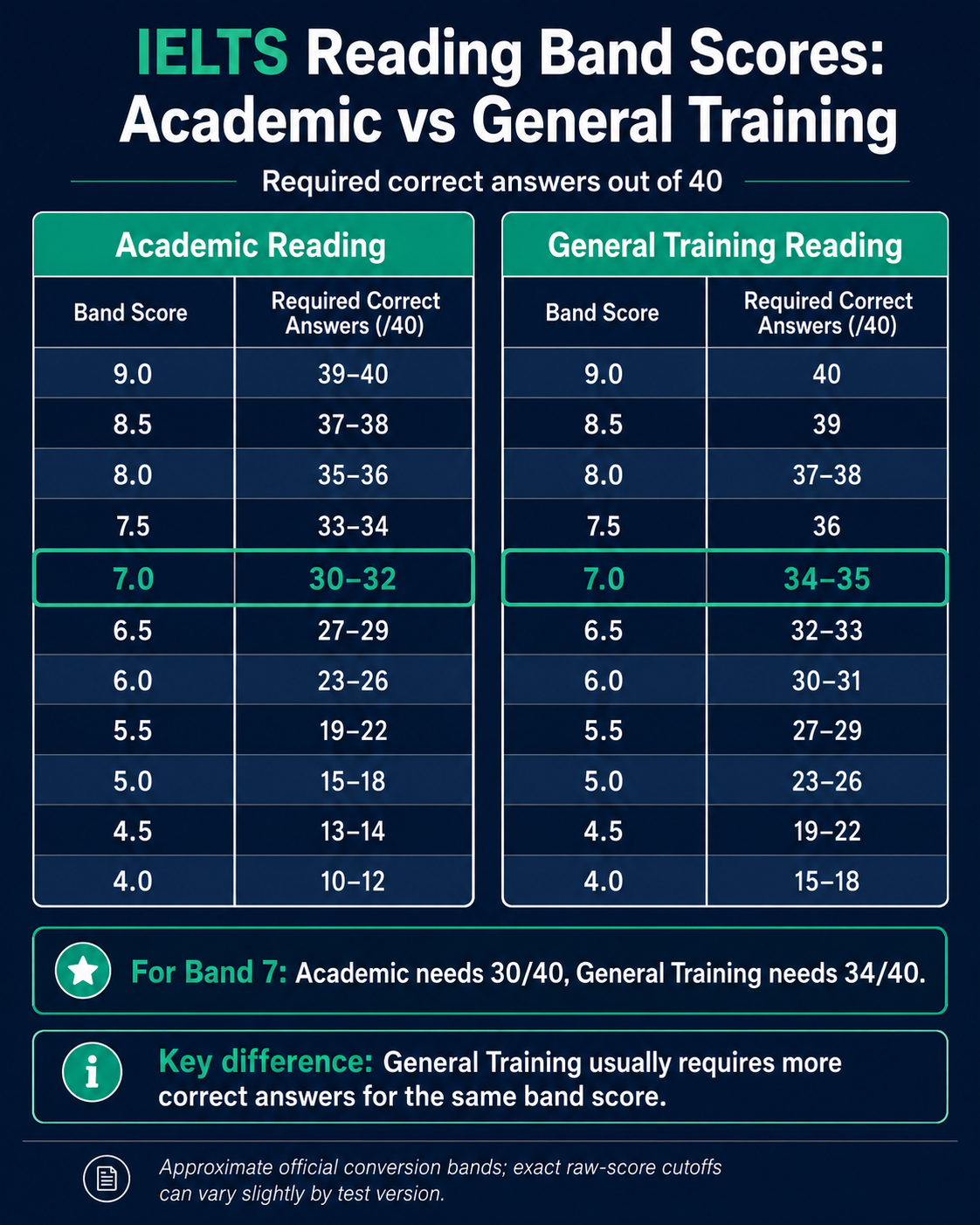
IELTS Reading band scores are calculated from your raw score out of 40, but the conversion table differs significantly between Academic and General Training. General Training requires more correct answers for the same band because the texts are easier overall. For Academic Reading you need 30 correct for band 7. For General Training you need 34 correct for the same band 7.
The test type matters for your overall result too. Switch between Academic and General Training in our band score calculator to see how your Reading raw score feeds into your overall band.
Academic and General Training use different raw-score conversions. Check the correct table, then choose your next step.
Reading band score at a glance
Both Academic and GT Reading conversion tables are documented in the official IELTS scoring guide.
Academic and General Training Reading use the same 9-band scale, but their raw-score conversions differ. IELTS states that the exact marks required can vary slightly between test versions. Always check the score requirement set by your institution or organisation.
Important: These are common conversion ranges. IELTS states that the precise marks needed can vary slightly between test versions. The tables below remain useful preparation guides.
Academic Reading conversion table
Academic Reading uses three long academic passages taken from journals, magazines and books. The vocabulary is more sophisticated than General Training, which is why fewer correct answers are needed for the same band.
| Band score | Raw score (Academic) | What this represents |
|---|---|---|
| Band 9.0 | 39-40 | Expert reader, near-perfect comprehension |
| Band 8.5 | 37-38 | Very good reader, handles academic complexity |
| Band 8.0 | 35-36 | Very good reader with consistent accuracy |
| Band 7.5 | 33-34 | Good reader with occasional misses |
| Band 7.0 | 30-32 | Good reader, university minimum standard |
| Band 6.5 | 27-29 | Competent reader, common visa minimum |
| Band 6.0 | 23-26 | Competent reader with noticeable gaps |
| Band 5.5 | 19-22 | Modest reader, struggles with complex text |
| Band 5.0 | 15-18 | Modest reader, basic competence only |
| Band 4.5 | 13-14 | Limited reader, frequent miscomprehension |
| Band 4.0 | 10-12 | Limited reader, struggles with most passages |
General Training Reading conversion table
General Training Reading uses everyday texts including notices, advertisements, work-related documents and a longer general interest article. The vocabulary is more accessible, so more correct answers are required for each band.
| Band score | Raw score (General) | Difference vs Academic |
|---|---|---|
| Band 9.0 | 40 | +1 needed |
| Band 8.5 | 39 | +1 to +2 needed |
| Band 8.0 | 37-38 | +2 to +3 needed |
| Band 7.5 | 36 | +2 to +3 needed |
| Band 7.0 | 34-35 | +3 to +5 needed |
| Band 6.5 | 32-33 | +4 to +6 needed |
| Band 6.0 | 30-31 | +5 to +8 needed |
| Band 5.5 | 27-29 | +5 to +10 needed |
| Band 5.0 | 23-26 | +5 to +11 needed |
| Band 4.5 | 19-22 | +5 to +9 needed |
| Band 4.0 | 15-18 | +5 to +6 needed |
The IELTS test designers calibrate both tests so a band 7 in Academic Reading equals a band 7 in General Training Reading in terms of language ability. The harder Academic texts require fewer correct answers because the cognitive load is higher per question.
What each Reading band represents
Beyond raw numbers, each Reading band represents a meaningful difference in reading ability. The descriptors below explain what each band actually means:
- Band 9. Expert reader. Understands complex academic text with full comprehension of vocabulary, structure and implied meaning.
- Band 8. Very good reader. Handles academic vocabulary and complex sentence structures with consistent accuracy.
- Band 7. Good reader. Understands complex texts with occasional difficulty in specialised vocabulary areas.
- Band 6. Competent reader. Handles general meaning well but loses accuracy on inference questions and complex vocabulary.
- Band 5. Modest reader. Understands basic texts but struggles with academic complexity and longer passages.
- Band 4. Limited reader. Basic comprehension only for familiar everyday texts.
The mistakes that cost most candidates half a band
Spending too long on individual questions
If a question takes more than 90 seconds, flag it and move on. Return at the end. Spending 4 minutes on one tough question costs you time for 3-4 easier questions later.
Confusing False with Not Given
"False" means the passage contradicts the statement. "Not Given" means the passage neither confirms nor contradicts. If you cannot find anything about the statement, the answer is Not Given, not False.
Exceeding word limits
"No more than three words" means three maximum. Exceeding the limit means your answer is marked wrong even if the words are correct.
Not transferring answers in time
Unlike Listening, there is no extra time at the end of Reading to transfer answers from the question booklet to the answer sheet. Allow 5 minutes for transfer within your 60 minutes.
The last 10 minutes of Reading are when most candidates lose marks. They rush through the final passage, leaving questions blank or guessing wildly. Reserve easier-looking Section 1 (General) or first passage (Academic) questions for late in the test if you need to come back to them.
How to improve your Reading band
Reading improvement is more predictable than Writing or Speaking because most candidates already understand the passages well enough. The improvements come from strategy, not language ability.
Focus on building reading speed. Daily reading of newspaper articles in English. Aim to read 600-800 word passages in under 10 minutes. Speed comes before strategy.
Focus on question-type strategy and time management. Master Matching Headings and True/False/Not Given specifically. Learn skim-and-scan technique to find answers without reading everything.
Our complete Reading preparation guide includes a 6-week study plan with daily targets matched to your starting band.
Frequently asked questions
Why do I need more correct answers in General Training Reading?
Because the texts are easier. IELTS calibrates both tests so that band 7 represents the same language ability regardless of test type. General Training texts are taken from everyday materials, so more correct answers are required to demonstrate the same proficiency level.
How many correct answers do I need for band 7 in Academic Reading?
You need 30-32 correct answers out of 40 for band 7 in Academic Reading. For band 6.5 you need 27-29, for band 7.5 you need 33-34 correct.
Is there extra time to transfer answers in Reading?
No. Unlike Listening, there is no extra time at the end of Reading to transfer answers from the question booklet to the answer sheet. The 60 minutes includes everything. On computer-based IELTS this is not an issue because you type directly into answer fields.
Are spelling mistakes penalised in Reading?
Yes. If the answer word is misspelled, the answer is marked wrong even if the meaning is clear. Both British and American spellings are accepted. This is one of the most common reasons candidates lose marks on questions they answered correctly.
Should I aim for Academic or General Training Reading?
Take whichever test type matches your goal. Academic is required for university admission and most professional registration. General Training is for immigration, work visas and secondary education. The choice is determined by your purpose, not by which is easier to score.