

IELTS scores range from 0 to 9 in half-band increments. Your overall band score is the average of your four module scores, rounded to the nearest half band. Each institution sets its own minimum band requirements.
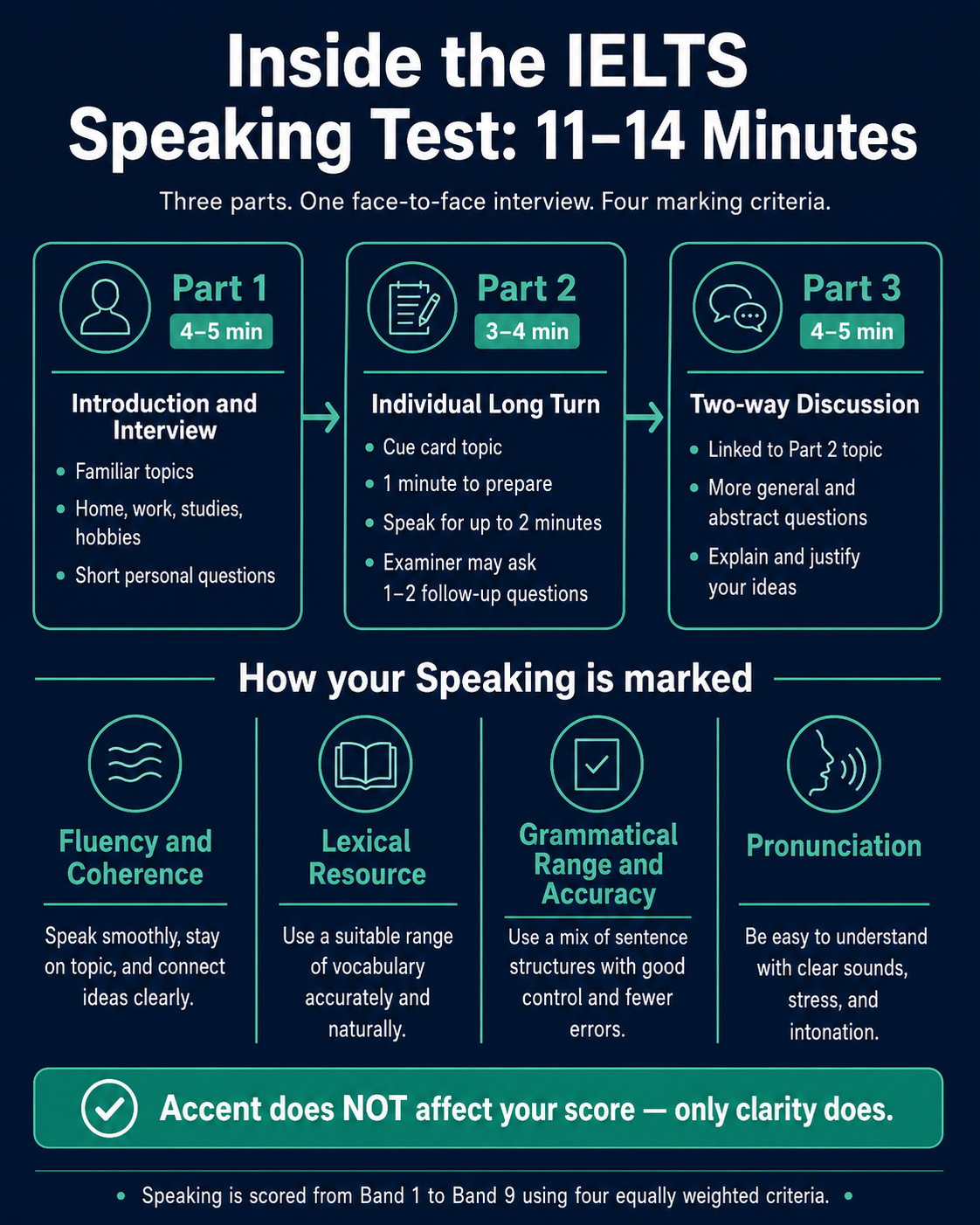
Your IELTS Speaking score is based on four equally weighted criteria: Fluency and Coherence, Lexical Resource, Grammatical Range and Accuracy, and Pronunciation. The examiner assesses your performance across all three parts of the 11-14 minute interview.
The Speaking test is the same for Academic and General Training. Your final score is the average of the four criteria scores, rounded to the nearest half band.
The Four Speaking Marking Criteria
Speaking is marked against four equally weighted criteria. Understanding what each one rewards is essential before any preparation strategy makes sense. Each is worth exactly 25% of your Speaking band.
Fluency & Coherence
Can you speak at length without too many pauses, hesitations or restarts? Do your ideas flow logically?
25% of bandLexical Resource
How wide and accurate is your vocabulary across different topics? Can you paraphrase when you do not know a word?
25% of bandGrammatical Range & Accuracy
Do you use a variety of complex structures (conditionals, passives, relative clauses) correctly?
25% of bandPronunciation
Are individual sounds, word stress and intonation clear enough for the listener to understand easily?
25% of bandThe most persistent misconception about IELTS Speaking is that strong accents lower your band. They do not. Examiners assess pronunciation clarity, not accent type. A strong Indian, Vietnamese, Russian or Korean accent does not lower your band if the examiner can understand you. What matters is individual sound clarity, word stress and intonation patterns.
Your ideas are not scored
Many candidates worry that their opinions are wrong or not clever enough. They are not marked on this. The examiner does not judge your ideas, your opinions or your general knowledge. You are scored only on your English. So you can give a simple, honest answer and still reach a high band. Speak clearly and develop your point. The content of the idea does not change your score.
The Band 6 to Band 7 Jump Explained
The most common Speaking plateau is band 6.5. Most candidates have the language ability for band 7 but lose marks on one specific criterion that holds the average down.
Communicates effectively but with hesitation. Vocabulary covers most topics adequately. Some complex sentences attempted but with errors. Pronunciation has features that occasionally distract the listener.
Speaks at length without noticeable effort. Uses range of vocabulary flexibly. Uses variety of complex structures with reasonable accuracy. Pronunciation has some L1 features but does not distract.
The key phrase is "without noticeable effort". Band 7 candidates sound natural when they speak. They are not visibly translating from their first language in real time. This naturalness only comes from accumulated speaking practice.
Speaking band score at a glance
All four criteria are defined in the official IELTS Speaking scoring criteria.
What Each Speaking Band Represents
The official band descriptors explain what examiners look for at each level. These descriptors are the same criteria your examiner is checking during your interview.
- Band 9 - Expert user. Speaks fluently with only rare repetition. Uses vocabulary with full flexibility and precision. Uses a full range of grammatical structures naturally. Pronunciation completely clear to all listeners.
- Band 8 - Very good user. Speaks fluently with only occasional repetition. Wide vocabulary range used flexibly. Wide range of structures, mostly error-free. Pronunciation easy to understand throughout.
- Band 7 - Good user. Speaks at length without noticeable effort. Uses vocabulary with flexibility and some idiomatic items. Variety of complex structures with reasonable accuracy. Pronunciation has some L1 features but does not distract.
- Band 6 - Competent user. Willing to speak at length, but loses coherence at times. Wide enough vocabulary to discuss topics. Mix of simple and complex structures with some errors. Pronunciation can be unclear at times.
- Band 5 - Modest user. Usually maintains flow of speech but uses repetition and hesitation. Manages to talk about familiar topics. Basic sentence forms with reasonable accuracy. Pronunciation has features that put strain on the listener.
- Band 4 - Limited user. Cannot respond without noticeable pauses and may speak slowly. Limited vocabulary, often inappropriate. Basic sentence forms with frequent errors. Pronunciation often unclear.
How your Speaking band is calculated
Your final Speaking band is the average of your four criteria scores, rounded to the nearest half band. Two examples to show how the calculation works:
FC: 7, LR: 6, GR: 6, PR: 7
Calculation: (7 + 6 + 6 + 7) ÷ 4
= 26 ÷ 4 = 6.5
Final band: 6.5
FC: 7, LR: 7, GR: 7, PR: 7
Calculation: (7 + 7 + 7 + 7) ÷ 4
= 28 ÷ 4 = 7.0
Final band: 7.0
Notice that in Example A, two strong scores of 7 are dragged down by two weaker scores of 6, giving a final band of 6.5. This is why targeting your weakest criterion is more effective than further improving your strongest one.
Band-by-criteria summary for Speaking
This table sums up what each band sounds like across the four criteria, in plain English. For the exact wording, always check the official IELTS Speaking band descriptors.
| Band | Fluency and Coherence | Lexical Resource | Grammar | Pronunciation |
|---|---|---|---|---|
| 9 | Speaks fully naturally with only rare repetition. | Very wide vocabulary used with full precision. | Full range of grammar used naturally and accurately. | Completely clear and easy to follow throughout. |
| 8 | Speaks fluently with only the odd pause or repeat. | Wide vocabulary used flexibly on any topic. | Wide range of structures, almost all error-free. | Easy to understand, first-language sounds do not distract. |
| 7 | Speaks at length without much effort or hesitation. | Good range with some less common words and paraphrase. | Variety of complex structures with reasonable control. | Some first-language features, but still clear. |
| 6 | Willing to speak at length, but coherence can slip. | Enough vocabulary for most topics, with repetition. | Mix of simple and complex forms, with errors. | Mostly clear, but some sounds reduce clarity at times. |
| 5 | Keeps going, but with frequent pauses and repetition. | Limited vocabulary, paraphrase is often needed. | Basic forms are more accurate than complex ones. | Some features strain the listener and reduce clarity. |
The mistakes that cost most candidates half a band
Memorising scripted answers
Examiners are trained to detect rehearsed responses and deduct marks immediately. Memorise vocabulary, phrases and ideas, never full answers. Spontaneous band 6 speech scores higher than memorised band 9 speech.
Speaking too fast to seem fluent
Rapid speech is not fluent speech. Speaking faster than you can think causes more grammar mistakes and unclear pronunciation. A measured pace at band 7 beats a rushed pace at band 5 every time.
One-word answers in Part 1
"Do you enjoy cooking?" answered "Yes" is a fluency failure. The expected response is 2-3 sentences with a specific example. Practice extending every answer naturally without padding.
Avoiding complex grammar in Part 3
Part 3 questions invite complex structures: conditionals, hypotheticals, passives, modal verbs of speculation. Candidates who only use simple present tense cap their Grammar score at band 6.
Planning an elaborate story for the cue card that you cannot finish in 2 minutes. The examiner will cut you off mid-sentence and move on, which disrupts your fluency score. Plan a simpler response you can complete cleanly in 1 minute 45 seconds.
Common Speaking requirements by goal
UK universities
Undergraduate: Speaking 5.5-6.0 minimum, 6.5-7.0 for competitive courses. Postgraduate: 6.5 minimum, 7.0+ for top universities. Speaking is often easier to score than Writing for non-native speakers.
Canadian PR
Speaking 6.0 corresponds to CLB 7 minimum. Speaking 7.0 corresponds to CLB 9 maximum points threshold. Speaking is often the easiest module for high points eligibility.
Australian skilled visas
Competent English requires Speaking 6.0. Proficient English requires 7.0. Superior English requires 8.0 across all four modules for maximum immigration points.
Healthcare registration
UK NMC requires Speaking 7.0. AHPRA Australia typically requires 7.0 across all modules. Healthcare professionals often find Speaking the easiest module to reach the required band.
How to Improve Your Speaking Band
Speaking is fundamentally a skill, not knowledge. You can only improve by actually speaking, regularly, ideally with feedback. The path depends on your current band.
Our complete Speaking preparation guide includes an 8-week study plan with daily practice activities.
Frequently asked questions
How is the IELTS Speaking band calculated?
Your Speaking band is the average of your four criteria scores (Fluency, Lexical Resource, Grammar, Pronunciation), rounded to the nearest half band. Each criterion is worth 25% of your band.
Does my accent affect my IELTS Speaking score?
No. Examiners assess pronunciation clarity, not accent. A strong Indian, Vietnamese, Russian or any other accent does not lower your band as long as the examiner can understand you easily. What matters is individual sound clarity, word stress and intonation.
Are each of the three Speaking parts marked separately?
No. The examiner gives you one overall band for each of the four criteria, based on your performance across all three parts combined. Your final Speaking band is the average of these four scores.
Once you have an estimate for Speaking, combine it with your other sections in our IELTS band calculator to see your overall band with the exact official rounding.
What if I cannot understand a question from the examiner?
You can ask for repetition or clarification without losing marks. Staying silent or guessing is what lowers your score. In Part 3 you can also ask what a word means if you genuinely do not know it.
Can I get band 9 in Speaking?
Yes, but it requires near-native speaker fluency, vocabulary range, grammatical accuracy and pronunciation clarity. Most band 9 Speaking candidates are bilingual or have spent years in English-speaking environments. The realistic target for most candidates is band 7-7.5.