

In this section
IELTS Writing Task 2 requires you to write a discursive essay of at least 250 words in about 40 minutes. The task is identical for Academic and General Training candidates, both write the same type of essay on the same kinds of topics. Task 2 contributes two-thirds of your Writing band score, making it the single most important piece of writing in the entire IELTS test.
Task 2 at a glance
Task 2 requires a minimum of 250 words in 40 minutes and is weighted twice as heavily - see the official IELTS Writing format.
Because Task 2 carries so much weight, getting Task 2 right matters more than perfecting Task 1. A strong essay at band 7 with an okay Task 1 at band 6 averages out higher than a polished Task 1 at band 7 with a rushed Task 2 at band 5.
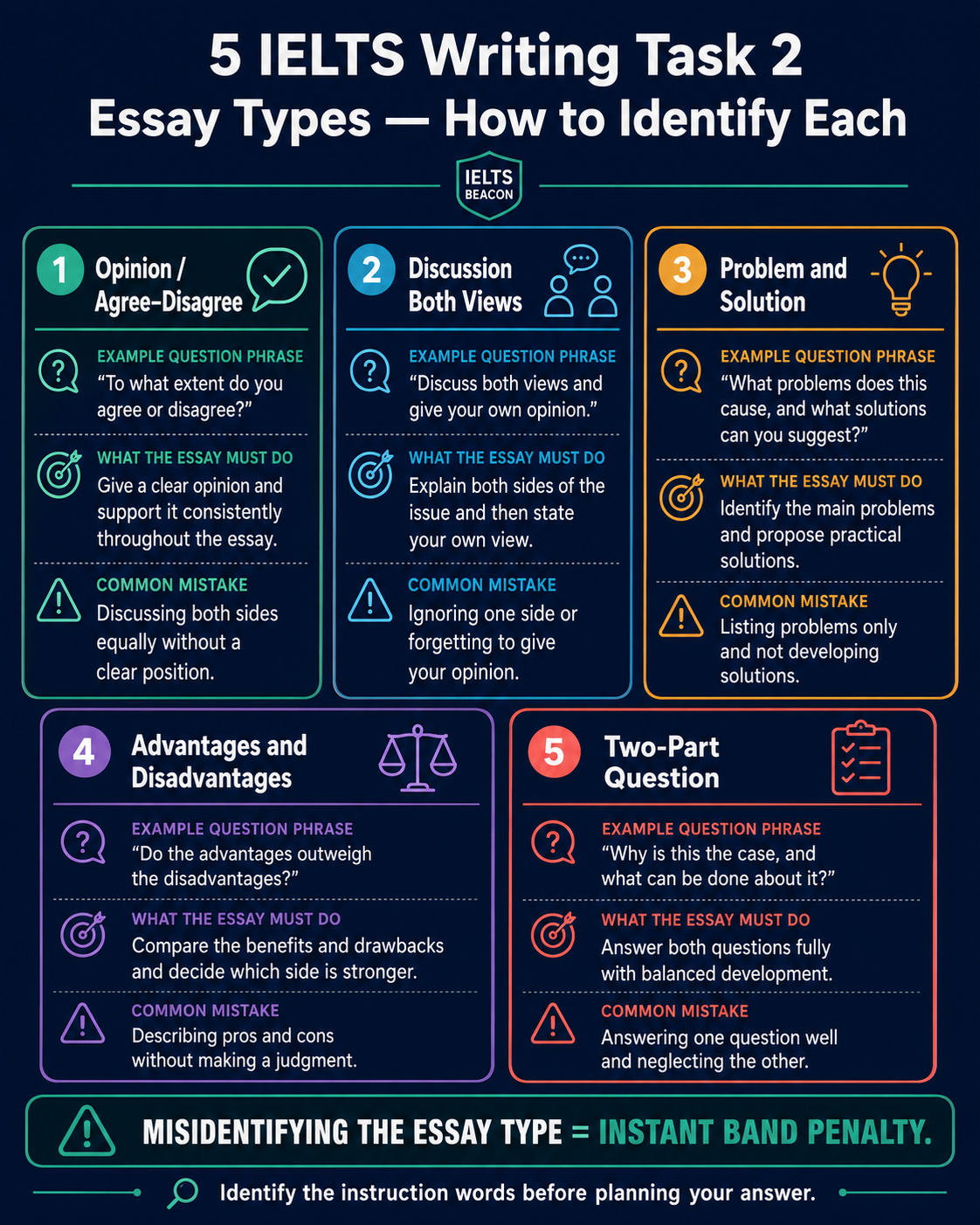
The five Task 2 question types
IELTS Task 2 prompts fall into five recognisable types. Identifying the type correctly is the first step, getting it wrong means writing the wrong kind of essay, which caps your Task Response score regardless of your English level.
Opinion (Agree / Disagree)
The question states a position and asks if you agree or disagree. You take a clear stance and defend it. Example: "Cars should be banned from city centres. To what extent do you agree or disagree?"
Discussion (Both views + opinion)
Two opposing views are given. You discuss both before giving your own opinion. Example: "Some say children should learn one language well. Others say multiple languages from a young age. Discuss both views and give your opinion."
Problem / Solution
A problem is described. You discuss causes and propose solutions. Example: "Many people live in cities far from their workplace. What problems does this cause and what solutions exist?"
Advantages / Disadvantages
A situation is described. You weigh the pros and cons. Sometimes asks if benefits outweigh drawbacks. Example: "Working from home is increasingly common. What are the advantages and disadvantages?"
The fifth type is the Two-part question, two distinct questions in one prompt that you must answer separately. Example: "Why is environmental damage increasing? What can be done about it?" Treat each question with its own paragraph.
Misreading the question type. A surprisingly large number of candidates write a Discussion essay when asked for their Opinion, or a Problem/Solution essay when asked for Advantages/Disadvantages. Read the question twice before planning. Identify the type explicitly before writing a word.
The five Task 2 question types at a glance
| Question type | What the prompt asks | Is your opinion required? | How to approach |
|---|---|---|---|
| Opinion (agree or disagree) | If you agree or disagree with a view | Yes | Take one clear side and defend it |
| Discussion (both views) | Discuss two opposing views | Yes | Cover both views, then give your own |
| Problem and solution | Causes of a problem and how to fix it | Optional | One paragraph on causes, one on solutions |
| Advantages and disadvantages | The good and bad points | Optional | One paragraph each, then weigh them up |
| Two-part question | Two separate questions in one prompt | Often yes | Answer each question in its own paragraph |
The four-paragraph structure that works for every type
While the content differs by question type, a four-paragraph structure works for all five types. This consistency makes planning faster and helps your Coherence score.
Introduction
Paraphrase question, state your position (~40 words)
Body paragraph 1
Main point with example/explanation (~90 words)
Body paragraph 2
Second point with example/explanation (~90 words)
Conclusion
Restate position, brief summary (~40 words)
Some band 8 candidates use three body paragraphs instead of two. This works but requires more time and tighter writing. For most candidates, two well-developed body paragraphs score higher than three rushed ones.
How Task 2 is marked
Task Response
Did you address all parts of the question? Is your position clear and consistent? Are your ideas developed enough?
25% of Task 2Coherence & Cohesion
Are your paragraphs logically organised? Do ideas flow naturally? Are linking devices used appropriately?
25% of Task 2Lexical Resource
How varied and accurate is your vocabulary? Can you discuss abstract ideas without repeating words?
25% of Task 2Grammatical Range & Accuracy
Do you use complex sentences correctly? Conditionals, passives, relative clauses?
25% of Task 2Planning Task 2 in 3 minutes
Three minutes of planning before writing transforms Task 2 essays. Candidates who skip planning and start writing immediately almost always score lower than candidates who plan briefly first.
- Minute 1. Identify the question type. Underline the key words in the prompt. Confirm what you are being asked to do.
- Minute 2. Brainstorm two strong points (your body paragraph topics). Write them as two short phrases, not full sentences.
- Minute 3. Decide your position (if applicable). Write a one-line plan: Intro → Point 1 → Point 2 → Conclusion. Pick one concrete example for each body paragraph.
Total planning time: 3 minutes. Total writing time: 32 minutes. Total checking time: 5 minutes. This is a band 7+ candidate's timing.
The mistakes we see most often
Writing without taking a position
If the question asks "to what extent do you agree", you must state your degree of agreement clearly. Sitting on the fence, presenting both sides equally without committing to a view, caps your Task Response at band 5. Pick a position, even if it is "I partially agree", and defend it consistently.
Generic examples that fit any essay
"For example, many studies have shown" is not an example. "For example, a 2019 study by Cambridge University found that..." is. Examples should be specific and verifiable, even if you have to invent reasonable details. Vague examples lower your Task Response and Lexical Resource simultaneously.
Memorised paragraphs about generic topics
Candidates sometimes memorise paragraphs about "technology", "education" or "environment" and try to fit them into any essay. Examiners spot this immediately because the memorised text rarely addresses the specific question. Better to write a slightly weaker original paragraph than a polished off-topic one.
Conclusion that introduces new ideas
The conclusion should restate your position and briefly summarise your main points. Introducing a new argument or example in the conclusion confuses the structure and lowers Coherence. Save your strongest material for the body paragraphs.
Many candidates write "On the one hand... on the other hand..." without ever committing to a view. They think this looks balanced and sophisticated. To examiners, it looks like the candidate could not decide. Take a clear position. You can acknowledge the opposing view briefly, but your stance must be unambiguous.
Band 6 vs Band 7, the same paragraph reworked
Here is a body paragraph from an essay arguing that governments should fund renewable energy. Written first at band 6, then at band 7.
"Renewable energy is good for the environment. It does not produce pollution like oil and coal. Also it does not cause climate change. For example, solar panels do not make any bad gases. So governments should support renewable energy."
"Renewable energy sources offer substantial environmental benefits compared to fossil fuels. Unlike coal or oil, solar and wind power generate electricity without releasing greenhouse gases, the primary driver of climate change. Denmark, for instance, has reduced its national emissions by 40% since shifting to wind energy. This evidence strongly supports increased government investment in clean alternatives."
For full Band 8+ model answers with detailed examiner commentary on every paragraph, see our Task 2 model answers page.
Choose your preparation path
Frequently asked questions
How many words should I write for Task 2?
Aim for 260-290 words. The minimum is 250, but writing slightly over gives you buffer if any words are copied from the question. Going significantly above 300 words is not penalised directly but tends to hurt quality because longer essays are harder to keep coherent.
Do I need to give my own opinion in Task 2?
For Opinion, Discussion+Opinion and Two-part questions, yes, clearly stated. For Problem/Solution and Advantages/Disadvantages questions, your opinion is optional unless the prompt specifically asks for it. Read each question carefully to determine what is required.
Can I use idioms and informal expressions in Task 2?
No. Task 2 requires academic register. Idioms, slang, contractions ("don't" should be "do not") and conversational phrases lower your Lexical Resource score even if the idioms are used correctly. Stick to formal academic vocabulary.
Is Task 2 the same for Academic and General Training?
Yes. The Task 2 prompt is identical for both test types, same topics, same question types, same marking criteria. Only Task 1 differs between Academic and General Training.
How do I improve from Task 2 band 6 to band 7?
The most common gap between band 6 and band 7 is idea development. Band 6 essays state ideas but do not develop them with examples, explanations or evidence. Band 7 essays take each idea further, explaining why it matters, providing specific examples, and acknowledging nuance. Practice developing each point with at least 3-4 sentences before moving to the next.