

IELTS letter writing is exclusive to General Training Task 1. You write a letter of at least 150 words in approximately 20 minutes, responding to a specific situation outlined in the question. The letter format, tone and structure depend on who you are writing to and why. The most common reason General Training candidates lose marks on this task is choosing the wrong tone for the recipient, not poor English. For how letters are marked across the four criteria, see IELTS Writing band scores.
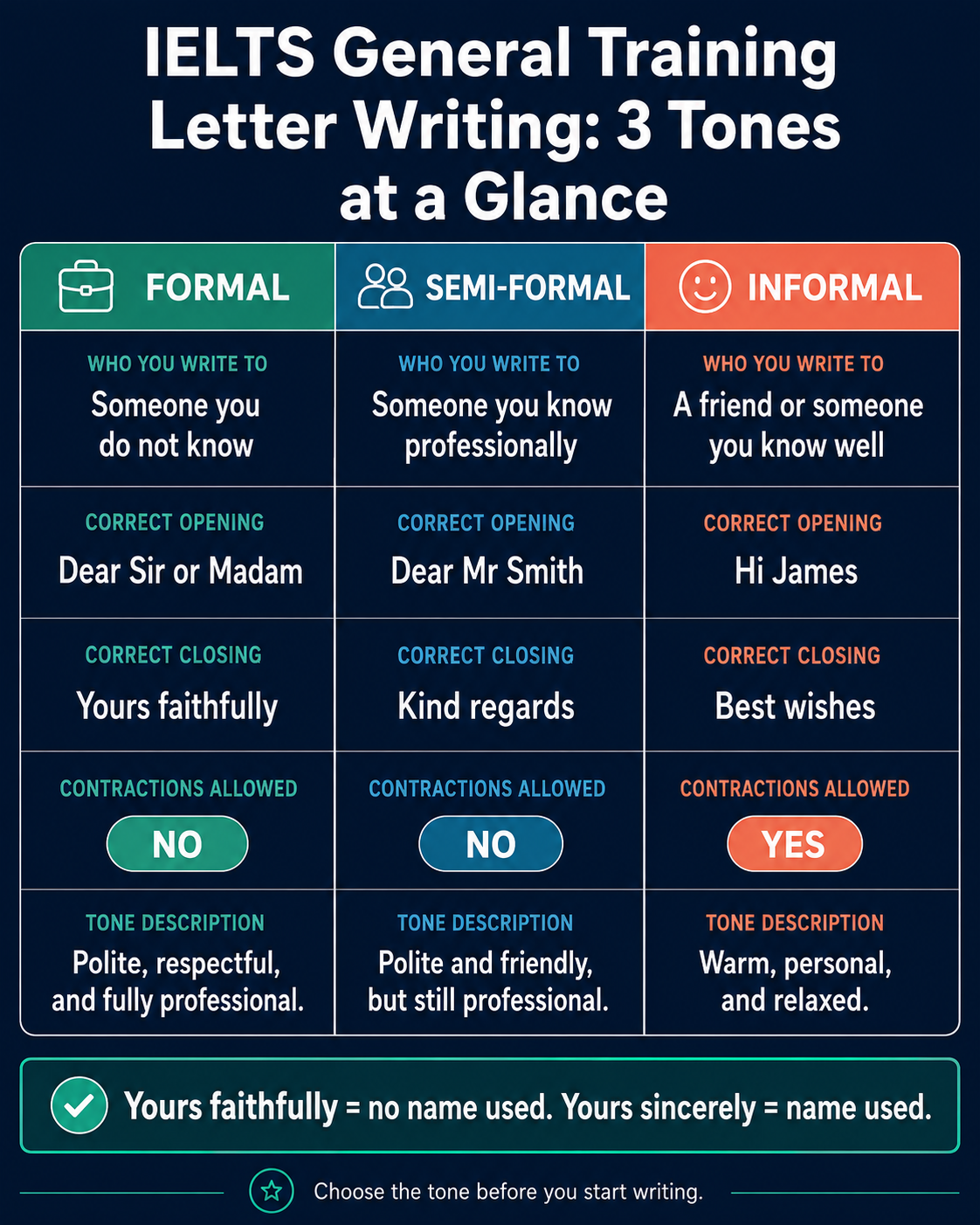
Letter writing at a glance
GT Task 1 is letter writing - see the official IELTS Writing format for the full test breakdown.
The three tones you must master
Every IELTS letter falls into one of three tones based on your relationship with the recipient. Getting the tone right is the most important factor in your Task Achievement score. The differences are concrete and learnable.
To unknown recipients
Used for companies, organisations, managers you do not know personally. Most common in Task 1 prompts (complaints, formal requests, business enquiries).
Opening: Dear Sir or Madam
Closing: Yours faithfully
To known roles
Used for people whose names you have but in professional contexts: your manager, your child's teacher, your landlord. Workplace and education matters.
Opening: Dear Mr Patel
Closing: Kind regards / Best regards
To friends and family
Used for personal correspondence with people you know well: friends, family members, close relatives. Invitations and personal news topics.
Opening: Hi James / Dear Sara
Closing: Best wishes / Take care
Tone identification
Read the question carefully to identify who you are writing to. The recipient is usually stated explicitly in the prompt: "Write a letter to your manager" or "Write a letter to your friend".
"Yours faithfully" goes with "Dear Sir or Madam" (no specific name). "Yours sincerely" goes with named recipients ("Dear Mr Patel"). Getting this combination right immediately signals to examiners that you understand formal letter conventions.
The structure that works for every letter
Regardless of tone or letter type, every IELTS letter follows the same five-part structure. Each section has a specific purpose and approximate length.
Greeting
Single line: Dear Sir/Madam, Dear Mr Smith, Hi James
Opening statement
1-2 sentences stating your purpose for writing
Body paragraphs
One paragraph per bullet point (3 paragraphs total)
Closing line
1 sentence wrapping up before sign-off
The opening statement is critical. Examiners look for it as evidence that you have identified the letter's purpose. Strong opening statements include:
- "I am writing to complain about a recent purchase from your store."
- "I am writing to apply for the management position advertised on your website."
- "I am writing to invite you to my wedding next month."
- "I am writing to request a reference for my upcoming job application."
- "I am writing to express my dissatisfaction with the service I received yesterday."
The 8 most common letter types
Most Task 1 letter prompts fall into 8 types. Each one has a usual tone and a key move to get right.
| Letter type | Usual tone | Example situation | Key move |
|---|---|---|---|
| Complaint | Formal | A faulty product or poor service | State the problem, then request a specific remedy |
| Request | Formal or semi-formal | Asking for time off or information | State the request, then justify it |
| Application | Formal or semi-formal | Applying for a job or course | Name the role, then give your relevant experience |
| Invitation | Informal | Inviting a friend to an event | Give the event, date and place, then what to expect |
| Apology | Matches the reader | Missing an event or making a mistake | Acknowledge it, then offer to make amends |
| Explanation | Formal or semi-formal | Explaining why something happened | Give the context, then clear reasons |
| Resignation | Formal or semi-formal | Leaving a job | State your last day, then thank them for the chance |
| Information request | Formal or semi-formal | Asking an organisation for details | Say what you need, then why and by when |
How letter writing is marked
Task Achievement
Did you address all three bullet points? Use appropriate tone? Maintain register throughout? Cover purpose clearly?
25% of bandCoherence & Cohesion
Logical structure? Clear progression? Linking between sentences? Each bullet point in own paragraph?
25% of bandLexical Resource
Vocabulary appropriate for tone? Range beyond basic words? Letter-specific phrases used naturally?
25% of bandGrammatical Range & Accuracy
Mix of sentence structures? Correct verb tenses? Modal verbs used naturally (would, could, should)?
25% of bandUseful phrases by tone
Use in formal letters
- "I am writing to..."
- "I would be grateful if..."
- "I look forward to hearing from you."
- "Please find enclosed..."
- "I would appreciate it if you could..."
- "Thank you for your assistance in this matter."
- "I trust that you will give this matter your urgent attention."
Use in informal letters
- "How are things with you?"
- "I thought I would write because..."
- "Hope you can make it!"
- "Cannot wait to see you."
- "Let me know what you think."
- "Take care and stay in touch."
- "Write back when you can."
The mistakes that cost most candidates half a band
Wrong tone for the recipient
The single most common reason candidates lose marks. Writing "Hi mate" to a manager or "Dear Sir/Madam" to a friend signals you have not understood the situation, even if your English is excellent.
Missing or rushing one bullet point
Each of the three bullet points must be addressed in detail. Skipping one or barely touching it caps your Task Achievement at band 5. Plan equal time for all three points.
Mixing formality in the same letter
Starting formal ("I am writing to inform you") then switching informal ("Anyway, thanks heaps") destroys cohesion. Pick one register and maintain it throughout.
Writing back in bullet points
Despite the bullet points in the question, your response must be written as connected prose. Writing back in bullets caps your Coherence at band 4.
"I am" required in formal letters. "I'm" acceptable in informal letters. Using contractions throughout a formal letter is a clear register error that examiners notice immediately. Match contraction use to letter type consistently.
Band 5 vs Band 7 letter opening compared
Here is the opening of a complaint letter at two band levels. The situation: writing to complain about a faulty appliance recently purchased.
"Dear Sir, I am writing because I bought a washing machine from your shop and it is broken. I need you to fix this problem because I paid a lot of money. The washing machine stopped working after one week only."
"Dear Sir or Madam, I am writing to express my dissatisfaction with a washing machine I recently purchased from your store. Despite paying a premium price for what was advertised as a top-of-the-range model, the appliance malfunctioned within just one week of installation, leaving me unable to do laundry for my family."
Frequently asked questions
Is letter writing only in IELTS General Training?
Yes. Letter writing is exclusive to General Training Task 1. Academic candidates write descriptions of visual data instead. Both tests share the same Task 2 essay format.
Should I use Yours sincerely or Yours faithfully?
If you addressed the letter to a specific name (Dear Mr Patel), close with "Yours sincerely". If you addressed it to a general title (Dear Sir or Madam), close with "Yours faithfully". This is one of the most reliable formal letter conventions.
Do I need to include a date and address?
No. IELTS does not require dates, addresses, or any letter formatting beyond the greeting and sign-off. Save those words for the actual content. Start directly with the greeting.
Can I use my real name when signing off?
No. Use a generic name like "John Smith" or "Sarah Brown". For informal letters, just first names are fine ("John", "Sarah"). Never use your real personal details on the test.
How long should each paragraph be in my letter?
Aim for 3-4 sentences per body paragraph (one paragraph per bullet point). The opening statement is 1-2 sentences. The closing line is 1 sentence. This gives roughly 170-190 words total, comfortably above the minimum.