

All answers on this page include the question number, correct answer and a brief explanation of where to find it in the passage or audio. Use these alongside the original Cambridge IELTS books for the best practice experience.
IELTS Listening answer keys help you review a test after the recording ends. Each guide shows all 40 accepted answers and explains the recording evidence behind them. Use the explanations to identify listening, spelling, distractor and instruction errors.
Listening answers at a glance
Spelling rules and transfer time are documented in the official IELTS Listening format.
Cambridge IELTS Listening Answers: Books 18 to 21
Choose your Cambridge book and test number. Each page contains all 40 answers with clear explanations.
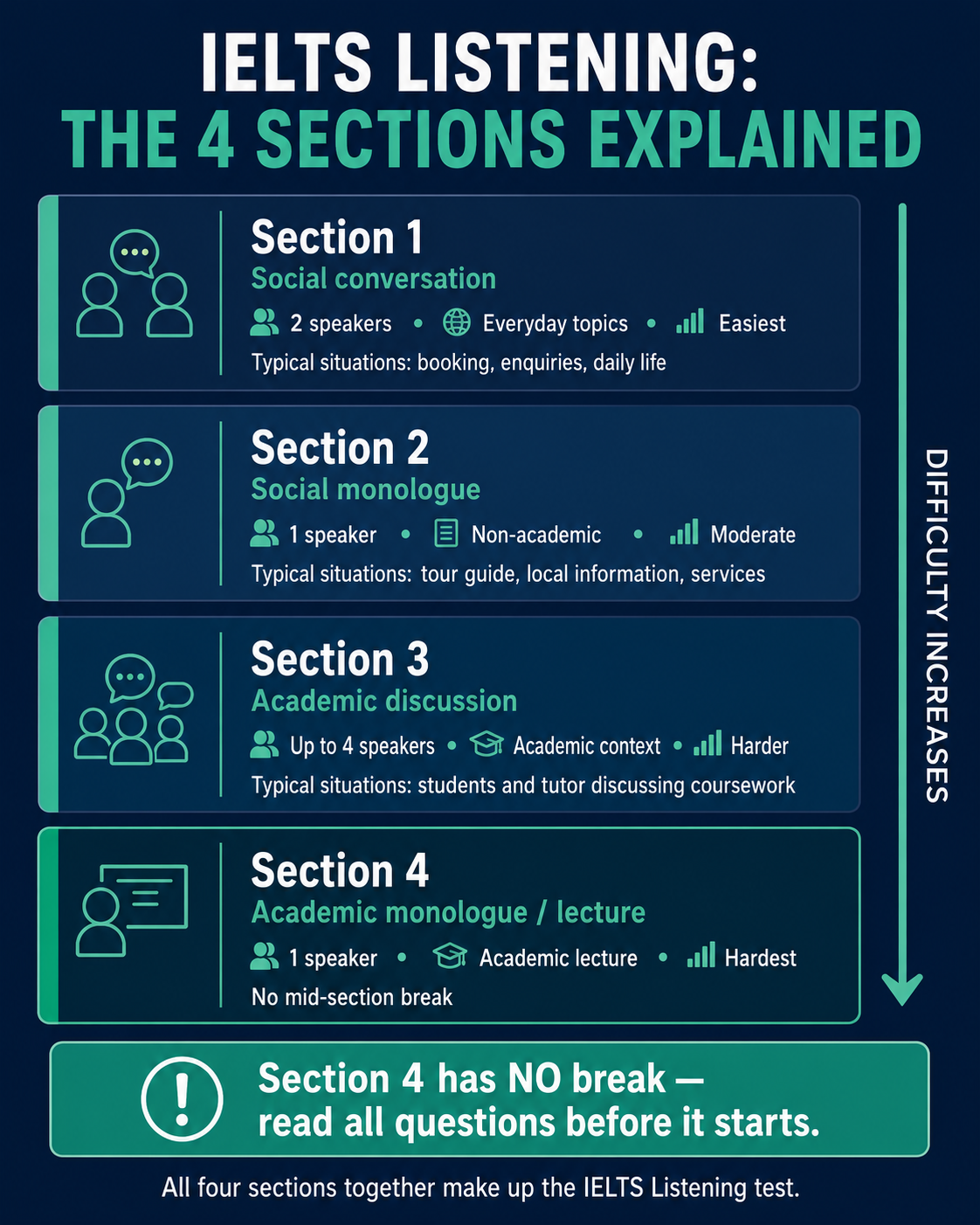
The 4 sections explained
Every IELTS Listening test follows the same 4-section structure. Difficulty increases as you progress. Understanding the structure helps you anticipate what to expect:
Section 1: Social conversation
Conversation between two people on everyday topics like booking accommodation, joining a class, or making inquiries. Clear accents, straightforward vocabulary. Most candidates score highly here. Common question types are form completion and short answers requiring names, dates and numbers.
Section 2: Social monologue
One speaker on a non-academic topic such as a tour guide, radio announcement, or workplace instructions. Map labelling and multiple choice are common. Watch for direction words (north, opposite, beside) in map questions.
Section 3: Academic discussion
Up to four speakers discussing an educational topic. Often students and a tutor planning a project. Multiple voices and academic vocabulary make this section harder. Matching and multiple choice dominate.
Section 4: Academic monologue
A single speaker delivering a university-style lecture. More sophisticated vocabulary, discusses concepts not just facts. No mid-section break, the recording goes straight through. Note completion and sentence completion dominate.
An answer key shows what is correct. An explanation helps you understand why. After marking, replay difficult sections and compare the recording with the answer evidence.
How to review Listening answers properly
The most valuable use of Listening answer keys is during structured review after a practice test. The protocol that produces real improvement:
Take the Full Test
Complete all 4 parts without pausing or replaying the recording
Mark with answer key
Identify correct, wrong, and spelling errors separately
Replay Difficult Parts
Use the audioscript when available and compare it with the explanation
Note error patterns
Were errors clustered in Section 3? Spelling? Specific question types?
The mistakes that cost most candidates half a band
Spelling errors on correct answers
"Accommodation" with one m, "Definitely" spelled "definately". These cost 2-3 marks per test on questions you actually heard correctly. Both British and American spellings are accepted, but misspellings are marked wrong.
Writing the first thing heard when there is a correction
"We meet on Tuesdays, actually no, Wednesdays now." The correct answer is Wednesdays. Always listen for correction markers like "actually", "sorry", "I mean".
Missing answers because you were writing previous ones
Keep moving with the recording. On paper-based IELTS, transfer answers carefully during the allowed transfer period. On computer-delivered IELTS, use the final checking time.
Leaving questions blank
There is no negative marking for wrong answers. A guess has some chance of being right, a blank has zero. Always write something, even if you are uncertain.
In paper-based IELTS, Section 4 starts immediately after Section 3 ends with no reading break in the middle. Many candidates expect a pause and miss the first 2-3 questions. Use the brief gap between sections to read all Section 4 questions in advance.
Why your listening answer was wrong, and how to fix it
An answer key helps most when you work out why you missed each one, not just how many. These are the reasons we see most often in Listening, with the fix for each.
| Why the answer was wrong | How to fix it next time |
|---|---|
| You heard the word but spelled it wrong | Practise the spelling of days, months, names and places. |
| You missed the plural "s" | Listen to the end of the word and decide if it is plural. |
| You wrote the first answer, but the speaker changed it | Keep listening, as speakers often correct themselves. |
| You wrote more words than the limit allowed | Check the word limit before the audio starts. |
| You fell behind after one hard question | Let it go and move on, as the audio does not wait. |
| You picked a word you heard, but it was a trap | Listen for meaning, as the answer is often a synonym. |
| You lost track in Section 4 | Read all the questions in the gap before that section starts. |
Common Listening answer types you will see
The most common answer types across Cambridge IELTS Listening tests:
- Names and proper nouns. Often spelled out letter by letter in the recording. Listen for "that's spelt", "with two l's", etc.
- Numbers, prices, dates, times. Listen for the format requested (currency symbols, am/pm, percentages).
- Common nouns. Usually 1-2 words from the recording. Check word limits carefully.
- Locations and directions. Common in map labelling. Listen for "north of", "next to", "opposite".
- Multiple choice letters. Eliminate clearly wrong options first.
Frequently asked questions
Where can I find official IELTS Listening answer keys?
The Cambridge IELTS book series contains official answer keys with transcripts at the back of each book. The transcripts are particularly valuable for review because you can see exactly what was said.
Is there negative marking in IELTS Listening?
No. There is no penalty for wrong answers. Always write something for every question, even if you have to guess. A blank guarantees 0 marks; a guess has some chance of being correct.
Are spelling mistakes penalised in Listening?
Yes. If the answer word is misspelled, the answer is marked wrong even if the meaning is clear. Both British and American spellings are accepted. Misspelling is one of the top reasons candidates lose Listening marks.
How do I review my Listening answers without official audio?
You need the official Cambridge IELTS book or audio file to re-listen to sections you missed. Without the audio, you cannot effectively review Listening mistakes. The audio is what made you miss the answer in the first place.
Can I use computer-based or paper-based IELTS answer keys interchangeably?
Yes. The Listening test content and answer keys are identical for both formats. Only the answer recording method differs (typing vs writing on the answer sheet).