

All answers on this page include the question number, correct answer and a brief explanation of where to find it in the passage or audio. Use these alongside the original Cambridge IELTS books for the best practice experience.
IELTS Reading answer keys help you understand exactly why each answer is correct, not just what the correct answer is. Looking up answers after a practice test only matters if you also understand the reasoning behind each one. Our Reading answer collection covers Cambridge IELTS passages with detailed explanations of where each answer appears in the text, why distractor options are wrong, and what reading strategy locates the answer most efficiently.
Cambridge IELTS Reading answers and explanations
Choose your book, test type and test number. Every guide includes all 40 answers with clear explanations.
Academic Reading
General Training Reading
Academic Reading
General Training Reading
Academic Reading
General Training Reading
Academic Reading
General Training Reading
Best way to review: Complete the timed Reading test first. Then mark all 40 answers and study each explanation. You can also browse Cambridge Reading tests.

Reading answers at a glance
Question types and timing are defined in the official IELTS Reading format.
Browse Reading answers by passage
Our answer keys cover the most-searched Cambridge IELTS Reading passages. Each answer page includes the complete answer key with explanations, the question types tested, vocabulary worth learning, and strategy recommendations for similar passages.
The Thylacine
Passage 1, Test 4. Cambridge IELTS 14 Academic. Covers extinction of the Tasmanian tiger. Medium difficulty, 13 questions with T/F/NG, sentence completion and multiple choice.
View answers → Cambridge 12William Henry Perkin
Passage 1, Test 5. Cambridge IELTS 12 Academic. Discovery of the first synthetic dye. Popular passage, narrative structure makes it accessible for band 6-7 candidates.
View answers →More Cambridge IELTS Reading answers will be added regularly. Bookmark this page to check for new additions, or browse our complete Cambridge IELTS guide for an overview of the whole series.
How to use Reading answer keys effectively
Looking at the answer key after a practice test is the obvious use. The more valuable use is during error review. The protocol that lifts most candidates by half a band:
Mark your answers first
Identify which questions you got right and wrong
For each wrong one
Find the answer location in the passage
Understand the trap
Why did you choose what you chose? What misled you?
Categorise the error
Comprehension, strategy, or careless? Track patterns.
Just knowing the right answer is B does not help you next time. Knowing why B is correct, why A and C are tempting wrong answers, and what specific words in the passage signal the correct choice, that knowledge transfers to every future test.
The 14 Reading question types explained
IELTS Reading uses 14 different question types across the test. Each requires its own strategy. Knowing each format in advance is the single biggest preparation advantage you can give yourself.
Matching Headings
You match a heading from a list to each paragraph. Appears in 70% of Academic tests. Save for last, takes the most time.
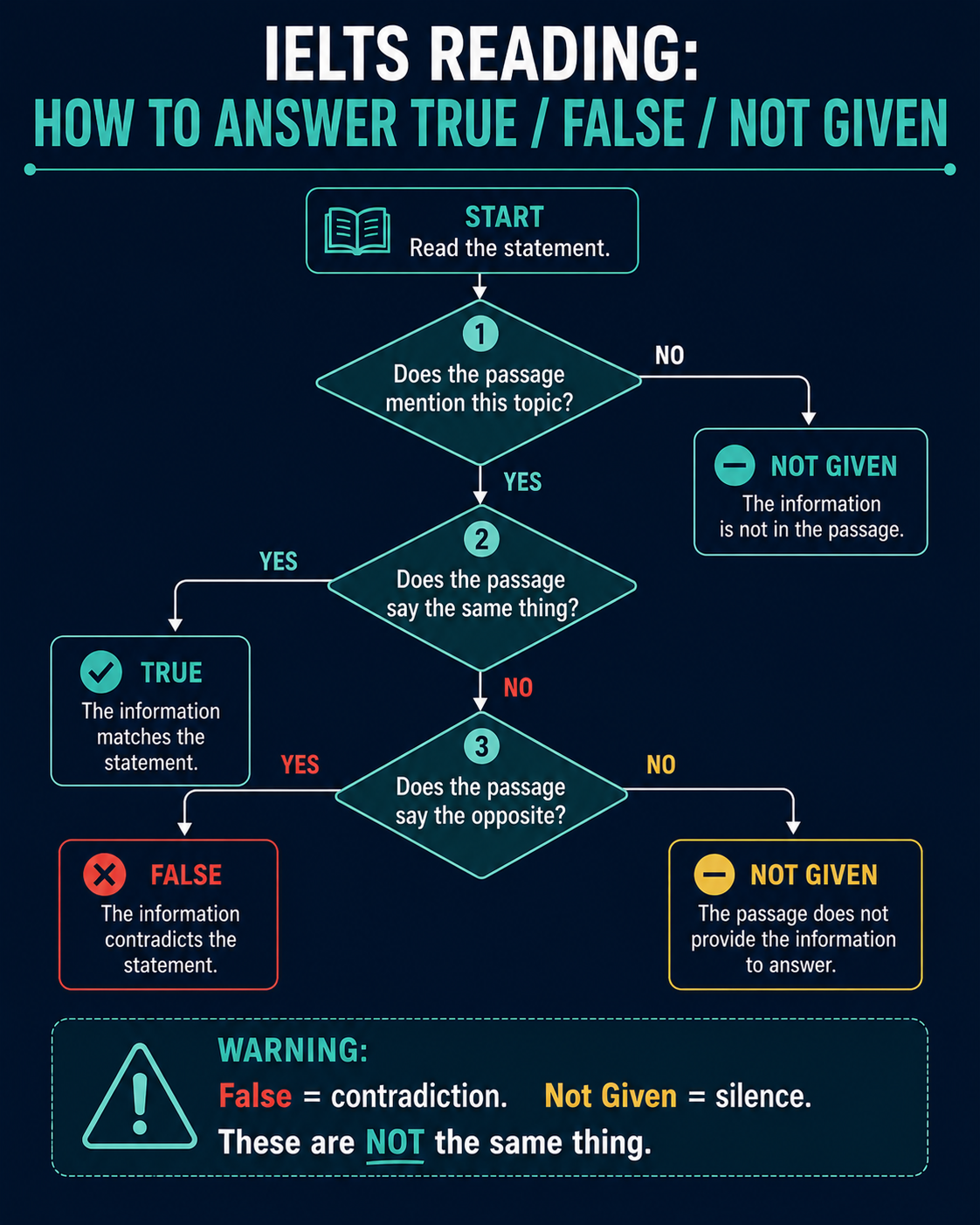
True / False / Not Given
Statement matches passage (True), contradicts it (False), or is not mentioned (Not Given). The Not Given option trips up most candidates.
Sentence Completion
Fill in a gap using words from the passage. Strict word limit, exceeding it means the answer is wrong.
Multiple Choice
Select one or more correct answers from a list. Wrong options are often deliberately tempting but technically incorrect.
Matching Information
Find which paragraph contains specific information. Look for paraphrased ideas, not exact word matches.
Note/Summary Completion
Complete a summary with words from a list or from the passage. Check whether words must come from the passage or a list of options.
The remaining question types include flow chart completion, diagram label completion, short answer questions, matching features, classification, and table completion. Our Reading preparation guide covers the strategy for each one in detail.
The mistakes we see most often when using answer keys
Reading the answer key first
Looking at the answers before attempting the questions defeats the purpose of practice. The mistakes you make in practice are exactly what you need to learn from. Always complete the test first, then check.
Marking right or wrong without reading explanations
You miss the most valuable learning opportunity. Even questions you got right deserve attention if you guessed or were uncertain. Understanding the reasoning is what transfers to future tests.
Trusting unofficial answer sources blindly
Some unofficial answer keys contain errors, particularly for True/False/Not Given questions. Always cross-check against multiple reliable sources or the official Cambridge IELTS book answer keys.
Skipping vocabulary review
Each Reading passage contains 15-25 academic words worth learning. Failing to note new vocabulary means the same unfamiliar words will slow you down in the real test.
Reviewing a practice test immediately after taking it (within 24 hours) is far more effective than waiting days. The decisions you made during the test are still fresh, so you can analyse why you made specific choices. Delay the review by a week and the insights are mostly lost.
Why your answer was wrong, and how to fix it
An answer key is most useful when you work out why you missed a question, not just how many. These are the reasons we see most often, with the fix for each.
| Why the answer was wrong | How to fix it next time |
|---|---|
| You matched a keyword, but the text used a synonym | Match the meaning, not the exact word. |
| You wrote more words than the limit allowed | Re-read the word limit before you write each answer. |
| The answer was right but spelled wrong, or a plural was missed | Copy the spelling exactly and check singular against plural. |
| You used your own knowledge, not the passage | Answer only from the text, as outside facts do not count. |
| You marked Not Given as False, or the reverse | Not Given means the text is silent. False means the text disagrees. |
| You mixed up True or False with Yes or No | True or False is about facts. Yes or No is about the writer's opinion. |
| You ran out of time on one passage | Give each passage about 20 minutes, then move on. |
Answer key reliability sources
Not all answer keys are equally reliable. The hierarchy of trustworthy sources:
- Cambridge IELTS books. Official past papers with official answer keys at the back of each book. These are the gold standard.
- Official IELTS practice materials. Published by IDP and the British Council. Two free practice tests per module with official answers.
- Reputable IELTS preparation sites. Established sites that explain their answer reasoning. Look for explanations, not just answer letters.
- Avoid: random forum posts and ad-heavy sites. These often have errors and lack proper explanations.
The Cambridge IELTS book series
The Cambridge IELTS books are the most reliable source of authentic practice material with official answer keys. They are real past papers, so the answer keys are definitive. The most useful books for current preparation:
- Cambridge IELTS 18 (latest). Most current question patterns. Best for final preparation.
- Cambridge IELTS 17, 16, 15. Recent enough to reflect current test format. Use these for bulk practice.
- Cambridge IELTS 14 and earlier. Still useful but slightly older patterns. Use for warm-up.
Our complete Cambridge IELTS guide covers which books to start with and where to find them.
Frequently asked questions
Where can I find official IELTS Reading answer keys?
The Cambridge IELTS book series contains official answer keys at the back of each book. These are the most authoritative answers because the books contain real past IELTS papers.
Should I read the answer key before or after the practice test?
After. Always. Looking at the answer key before defeats the purpose of practice entirely. The mistakes you make in practice are exactly what you need to learn from.
Are answer keys with explanations more valuable than answer-only keys?
Yes, significantly. Knowing the right answer is B does not help you next time. Knowing why B is correct, why A and C are tempting wrong answers, and what passage clues signal the correct choice, that transfers to future tests.
Can I use Reading answers from older Cambridge books?
Yes. Cambridge IELTS books 9-14 are slightly older but still use the same question types and format. They are valuable practice material. The answer key format is identical across all Cambridge IELTS books.
How do I know if an unofficial answer key is reliable?
Reliable answer keys explain the reasoning, not just provide letters. They cite specific lines from the passage. They explain why distractor options are wrong. If the source only provides answers without explanations, treat them with caution and cross-check.