

Part 2 of the Speaking test is the part most candidates dread. You get a card with a topic and four bullet points, exactly one minute to plan, and then you have to talk. For two minutes. Alone. While the examiner watches. No interruptions, no help, no easy way out.
Here is the good news. Part 2 is also the most predictable part of the entire IELTS exam. The same topic categories appear over and over. Personal experiences, descriptions of places, descriptions of people, opinions on objects, abstract concepts. Master the structure and the rest is practice.
What you actually need to do in Part 2
The Part 2 cue card task is described in the official IELTS Speaking format.
Most candidates we work with assume the examiner is judging every word. They are not. They are listening for evidence across the whole response. One brilliant sentence does not save you. One terrible one does not sink you. The overall impression is what matters.
Browse our cue card collection
Here are the cue cards we have built model answers for, organised by topic category. Click any to see the full cue card, a band 7+ model answer with annotations, and topic-specific vocabulary you can adapt.
Describe a person who influenced you
One of the most common cue cards in recent IELTS tests. Model answer covers parents, teachers and mentors with adaptable structure.
See model answer → EventDescribe a memorable journey
Travel topics appear in roughly 30% of recent tests. Model answer shows how to handle both pleasant and difficult journey memories.
See model answer →We will keep adding model answers as we develop more. Bookmark this page or check back monthly.
The five cue card topic categories
If you have looked at multiple recent IELTS Speaking tests, you will notice the cue cards are not as varied as they first appear. They cluster into five recognisable categories. Each category has its own optimal structure.
Describe a person
Family member, friend, teacher, public figure, role model. The structure is consistent: who they are, how you know them, what they are like, why they matter to you. Roughly 25% of recent tests use this category.
Describe a place
City, country, building, room, landscape, holiday destination. Structure: where it is, what it looks like, what you do there, why it is special. About 20% of recent tests.
Describe an object
Something you own, a gift, a piece of technology, a tool, clothing. Structure: what it is, when you got it, what it does, why it matters. Around 15% of recent tests.
Describe an event or experience
Journey, celebration, achievement, difficulty overcome, memorable day. Structure: when, where, what happened, how you felt. About 25% of recent tests.
Describe an abstract concept
A skill you want, a goal, a tradition, a piece of advice. Less common but harder. Structure: what it is, why it matters, how it relates to you. Roughly 15% of tests.
The five cue card categories and what each one needs
Almost every cue card falls into one of five types. If you prepare one strong story for each, you can adapt it to most cards. This table shows an example for each and the one thing examiners most want to hear.
| Category | Example cue card | What examiners most want |
|---|---|---|
| People | Describe a person who influenced you | A clear description, then why they matter to you. |
| Places | Describe a place you like to visit | Sensory detail, then why it is special to you. |
| Objects | Describe a gift you received | What it is, then its value or meaning to you. |
| Experiences and events | Describe a memorable journey | A short story with a beginning, middle and end. |
| Activities and habits | Describe a hobby you enjoy | What you do, then why you keep doing it. |
Honest opinion on the most common Part 2 mistakes
After watching countless practice sessions, certain mistakes appear constantly. Here are the ones that genuinely cost candidates marks. Not theoretical issues, real ones.
Planning an elaborate story you cannot finish
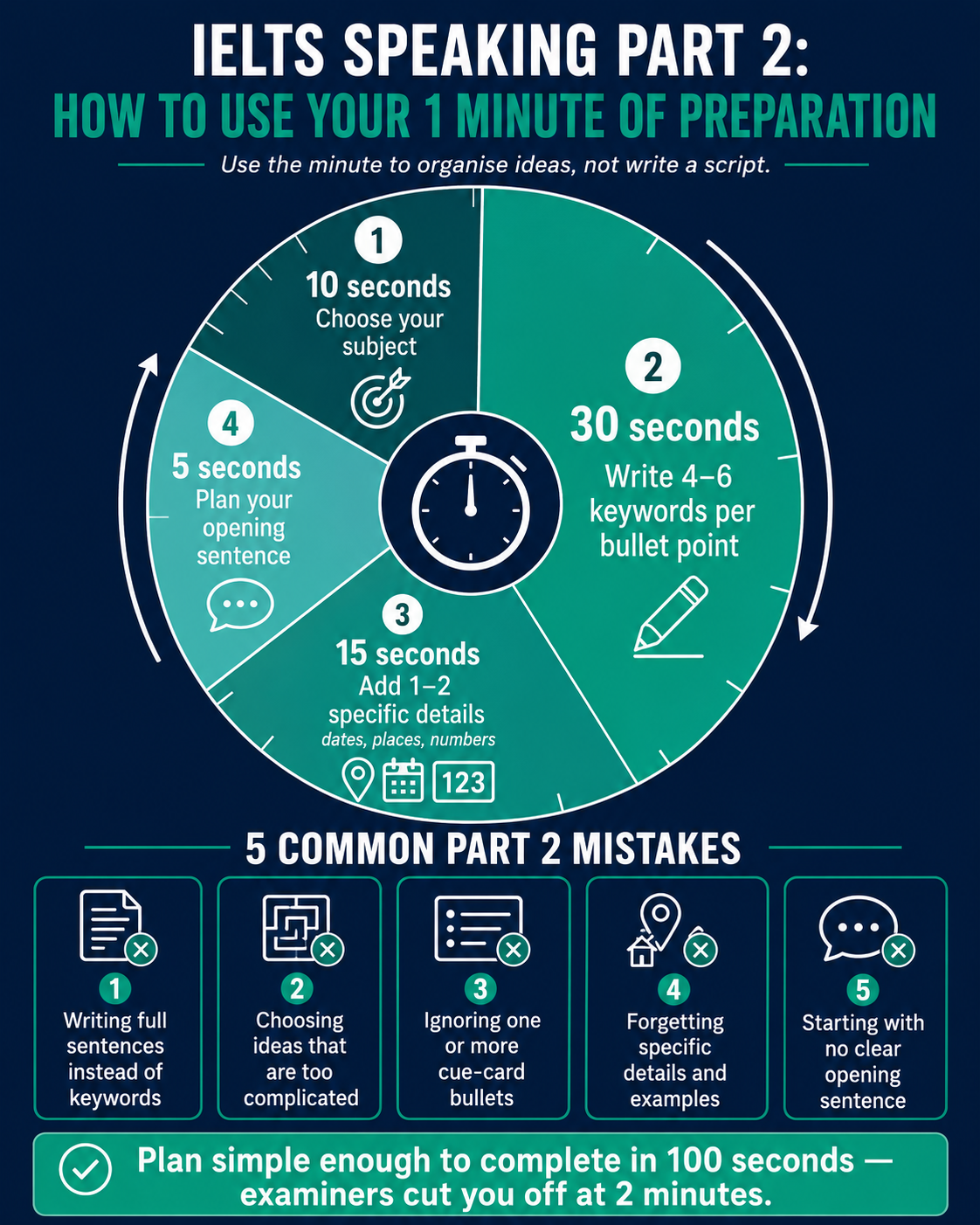
This is the biggest one. Candidates plan a complex narrative with multiple subplots, run out of time at 90 seconds, and get cut off mid-climax. The examiner does not care that your story was going somewhere amazing. Plan something you can complete in 100 seconds. Aim to finish naturally, not be interrupted.
Memorising answers from sample books
Examiners hear thousands of responses. They spot memorised answers within the first 20 seconds. Once they spot it, your Task Response score drops dramatically. We see this constantly with candidates who have studied from popular IELTS preparation books.
Speaking too fast because you are nervous
This kills more bands than almost anything else. Candidates who speak at 200 words per minute make twice as many grammar errors as candidates who speak at 130 words per minute. Slow down. Genuinely.
Treating the bullet points as a checklist
"Now I will tell you who this person is. He is my father. Now I will tell you when I met him. I have known him my whole life." This is robotic. Use the bullet points as a guide, not a script. Connect ideas naturally.
Memorising lists of "band 8 words" rarely helps. Examiners are smart. They notice when you say "myriad" and "plethora" out of nowhere in an otherwise band 6 response. Use vocabulary you genuinely understand, even if it is simpler. Authentic English beats forced English every time.
How to use the one minute of planning time
One minute feels like nothing. Then suddenly you are talking. Here is how to actually use that minute effectively.
10 seconds
Pick your specific subject (which person, which place)
30 seconds
Write 4-6 keywords for each bullet point
15 seconds
Add 1-2 specific details (numbers, places, dates)
5 seconds
Pick your opening sentence in your head
That is it. Do not write full sentences. Do not try to plan every word. Trust yourself to fill in the connections when you actually speak. Notes should be triggers, not scripts.
What examiners actually want to hear
Here is something nobody tells you. Examiners are trained to give you the benefit of the doubt. They want you to do well. They are not looking for reasons to mark you down. They are listening for evidence of certain things.
- Fluency. Can you keep talking without long uncomfortable pauses? Some hesitation is fine. Long stretches of silence are not.
- Range. Do you use a variety of structures and vocabulary? Or do you say "good" eight times in two minutes?
- Accuracy. Are your sentences mostly correct? Mistakes are expected. Constant mistakes are not.
- Clarity. Can the examiner understand you easily? Strong accents are fine. Unclear pronunciation is not.
That is what they are listening for. Not perfection. Not memorised brilliance. Evidence of these four things consistently across the whole response.
Frequently asked questions
Can I take notes during the one minute of planning?
Yes, definitely. You are given a pen and paper. Use them. Notes should be keywords only, not full sentences. The examiner will not look at your notes during your response. You can refer to them while you speak.
What if I cannot think of an answer to the cue card topic?
You can talk about a hypothetical or made-up example as long as the examiner cannot tell. They are not fact-checking your life. A common strategy is to talk about something similar but not exactly what the card asks. As long as you address the bullet points, it works.
What happens if I finish before two minutes?
If you finish significantly early (under 90 seconds), the examiner may ask a brief follow-up question to fill the time. This usually does not affect your band score directly, but extended responses are generally better than short ones for demonstrating fluency.
Can the examiner stop me before two minutes?
Yes, but only at the two-minute mark. The examiner will not interrupt you before then unless you are completely off-topic. At exactly two minutes, the examiner will stop you mid-sentence if necessary, which is why finishing naturally around 100 seconds is ideal.
Do all four bullet points carry equal weight?
Roughly yes. You should address all four bullet points, though depth matters more than equal coverage. Spending 30 seconds each on bullets 1 and 2 with 1 minute on bullet 3 is fine as long as you mention bullet 4 briefly.